Table of Contents
- Introduction: Redefining the Guest Experience at Weddings
- What Is a Private Estate Wedding?
- The Emotional Impact of Celebrating in an Intimate Setting
- How Exclusive Spaces Encourage Genuine Connections
- Staying Together: The Power of On-Site Accommodation
- Unhurried Celebrations and Meaningful Moments
- Designing Experiences That Guests Truly Remember
- Private Estate Weddings vs Conventional Venues
- Why Modern Couples Are Choosing Estate-Style Celebrations
- Creating Lasting Bonds Through Thoughtful Wedding Design
- Conclusion: Weddings That Feel Personal, Not Performative
Introduction: Redefining the Guest Experience at Weddings
There is a moment at every Indian wedding when the evening tilts from spectacle to something softer. It might happen when a cousin finally sits down after hours of hosting duties, or when the bride’s grandmother quietly notices the mehendi on her hands and smiles without saying much. These moments are rarely planned, and yet they are the reason families still believe in the power of gathering.
In recent years, the conversation around weddings has started to shift. Couples are still drawn to beauty, scale, and celebration, but they are also asking a different, more intimate question: Will our guests actually feel close to us, and to each other, when this is over? That question is at the heart of why private estate weddings are no longer a niche trend but a cultural mood. When the venue feels like a shared home rather than a rented hall, the guest experience at weddings changes, subtly at first, and then completely.
What Is a Private Estate Wedding?
A private estate wedding is less about a category of property and more about a philosophy of hosting. Instead of stepping into a conventional venue designed for back-to-back events, guests arrive at a space that feels singular for the weekend: a landscaped campus, a heritage home, a villa-style property, or a purpose-built estate that functions like a private enclave.
Many private wedding venues in India now blur the line between “destination wedding” and “city wedding.” They offer the privacy and immersion of travel without always requiring a flight to a beach or palace town. In that sense, estate weddings are increasingly becoming destination-style weddings in India, not because they are far away, but because they create that same feeling of being transported.
At their best, luxury private estate weddings bring together three things that are hard to find in one place: design continuity, logistical comfort, and emotional warmth.
The Emotional Impact of Celebrating in an Intimate Setting
In traditional Indian hosting, intimacy is not measured by guest count alone. It is measured by recognition, whether people feel seen, included, and held by the flow of the celebration. That is what intimate wedding venues quietly enable.
In an estate setting, the physical scale is often expansive, but the emotional scale becomes more personal. Guests are not scattered across disconnected halls and corridors. They aren’t constantly recalibrating, Where do we go next? Who is hosting? Is this the right entrance? Instead, they settle in. They begin to behave like they belong.
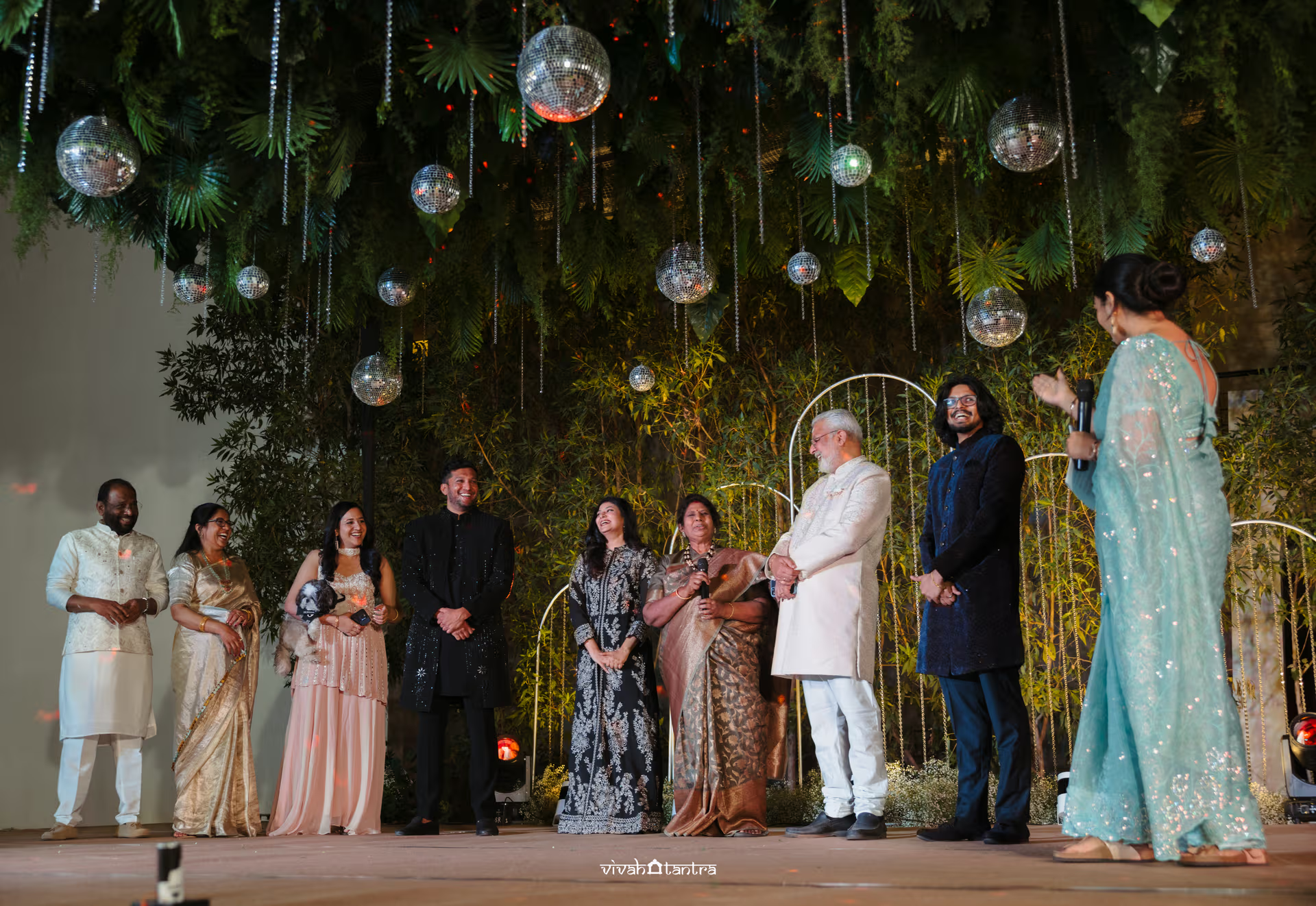
This sense of belonging has a direct emotional payoff. When people feel relaxed, they become more generous with their attention. They linger longer at rituals. They notice details. They share stories that might otherwise be postponed to “some other time.” The wedding stops feeling like a production they are watching and starts feeling like a gathering they are part of.
How Exclusive Spaces Encourage Genuine Connections
A large banquet venue can be efficient, even glamorous. But it can also be porous: too many entry points, too much ambient noise, too many competing events in the same building. The result is a subtle social fragmentation, guests drift into smaller clusters and stay there.
Exclusive wedding venues, by contrast, create a kind of shared perimeter. When the entire property is devoted to one family’s celebration, the atmosphere changes in ways guests feel immediately:
The couple becomes more accessible. Not in a formal “meet and greet” sense, but in the natural way people cross paths when they are living in the same world for a day or two.
Families host more organically. Hosting stops being a duty performed at the gate and becomes a rhythm, welcoming people in the lobby, checking on elders at breakfast, finding friends during a pause between functions.
Conversations deepen. Because guests aren’t rushing to leave after the reception, they often reconnect with relatives and friends they haven’t seen in years. That reconnection, more than the décor, becomes the memory.
This is the quiet genius of estate wedding celebrations: exclusivity doesn’t isolate; it concentrates. It brings people into the same narrative.
Staying Together: The Power of On-Site Accommodation
One of the most underestimated reasons guests feel more connected at estate weddings is also the most practical: people stay.
Wedding venues with accommodation change the tempo of an Indian wedding. The day no longer depends on traffic, late arrivals, or the mental exhaustion of coordinating transport between home, hotel, and venue. Instead, it creates a shared micro-community, where uncles run into each other near the coffee counter, where bridesmaids knock on doors to gather everyone for haldi, where elders can rest without feeling like they’re missing everything.
For multi-day celebrations, this matters enormously. When guests are on-site, they don’t experience the wedding as “functions.” They experience it as time. Time to wake up slowly, to dress without panic, to sit with family between events. Even the in-between moments, those small hours that never make it to the album, start to feel like the real celebration.
In practice, on-site stays also improve the guest experience at weddings for people who often get overlooked: elderly family members, guests with children, and outstation friends who don’t know the city well. Comfort becomes inclusion.
Unhurried Celebrations and Meaningful Moments
Indian weddings are often accused of being long, but what guests actually feel is not length, it is haste. A ceremony that runs late, a dinner line that is too crowded, a reception that becomes a blur of selfies and stage calls. When time is poorly held, even the most beautiful wedding can feel emotionally thin.
Private estate weddings tend to solve this without trying too hard. Because everything is within one campus, the schedule gains elasticity. Functions can breathe. Rituals can be witnessed, not just completed.
That unhurried quality is what allows meaning to surface. A father can linger after the varmala instead of being pushed toward the next photo. Friends can sit with the couple after the pheras instead of chasing the DJ set. A bride can actually eat a meal. These may sound like small mercies, but they are the difference between a wedding that looks good and a wedding that feels good.
In many intimate wedding celebrations in India, this is the real luxury: not marble or imported florals, but the ability to be present.
Designing Experiences That Guests Truly Remember
Estate settings invite a different kind of design thinking. When planners and event designers work with an estate, they aren’t simply dressing a stage, they are shaping a journey.
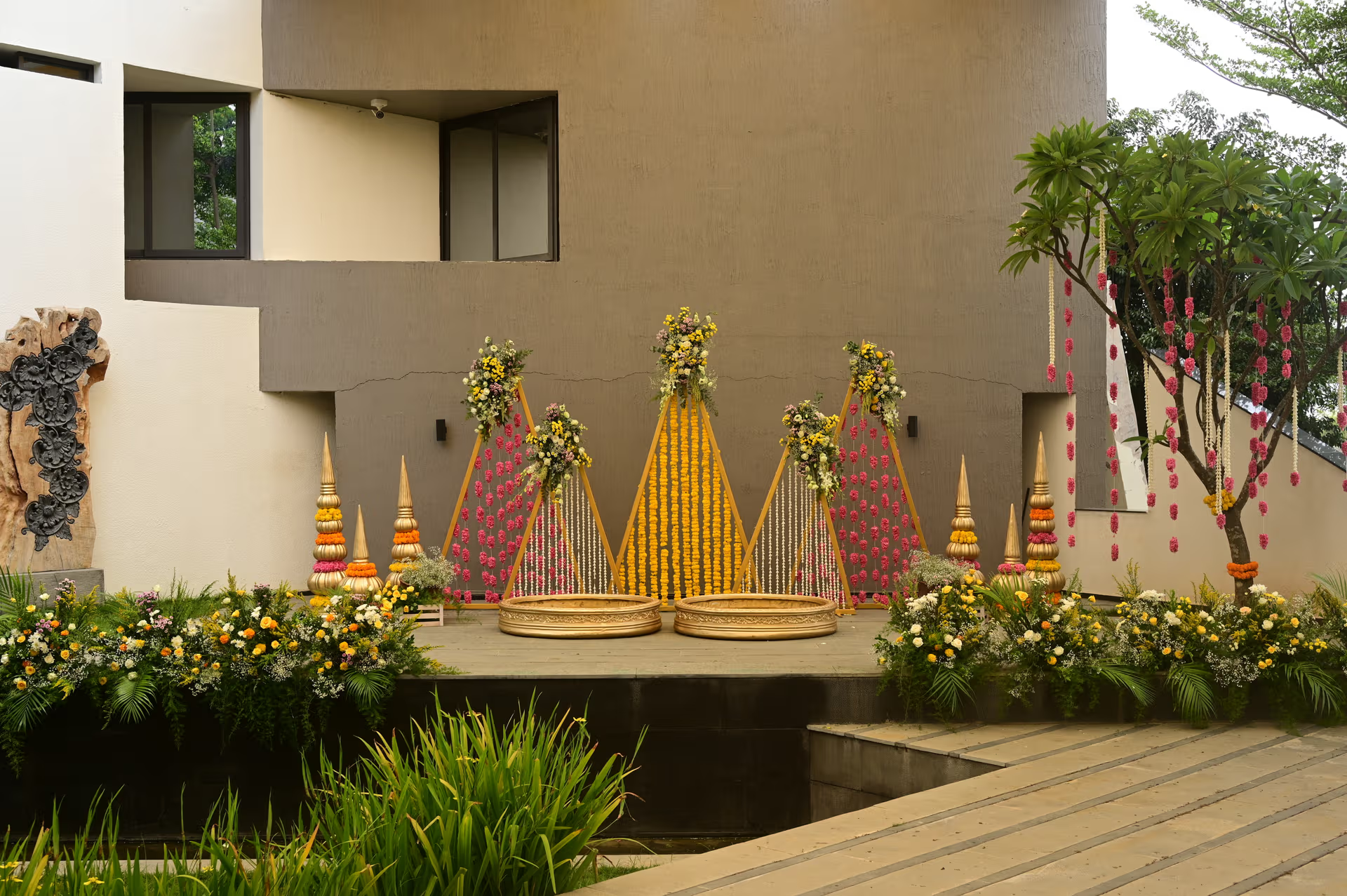
A well-designed estate celebration uses the environment to create emotional chapters: a quiet, sunlit space for haldi; a poolside evening for sangeet that feels like a holiday; a garden ceremony that carries the softness of morning; a reception where the lighting is not just dramatic but flattering, intimate, cinematic.
Because estate venues often have multiple “experience zones,” the wedding can move like a story. Guests remember not only what they saw but how they moved through it, where they met someone, where they danced, where they had that late-night conversation that felt unexpectedly honest.
This is why estate weddings guest experience often reads as more personal. When the venue itself participates in the narrative, guests stop feeling like they’re attending an event and start feeling like they’re inhabiting a world.
Private Estate Weddings vs Conventional Venues
The difference is not simply aesthetic; it is structural.
Conventional venues are built for turnover. They are designed to host many families across many dates, with standardised flows that prioritise efficiency: separate entrances, fixed stage positions, predetermined dining layouts. This can work beautifully for some celebrations, especially when time and scale demand predictability.
But private estate weddings are built for immersion. They typically offer:
- A sense of privacy that reduces social noise and increases emotional focus.
- A campus-like layout that allows multiple functions without feeling repetitive.
- The possibility of accommodation that turns attendance into togetherness.
- A stronger relationship between the host family and the space, which guests can sense.
In other words, the estate format is not automatically “better,” but it is inherently more conducive to connection, especially when the intention is to create closeness rather than simply manage crowds.
Why Modern Couples Are Choosing Estate-Style Celebrations
Modern couples are not rejecting tradition; they are negotiating it. They still want rituals, family participation, and cultural richness. But they also want ease, aesthetics, and a guest experience that feels thoughtful.
Estate-style celebrations answer a very contemporary desire: the wedding should feel like a reflection of the couple’s life, not a performance staged for approval. This is why “estate” has become shorthand for a certain sensibility, curated, warm, and quietly elevated.
It also aligns with how luxury is evolving in India. Today, luxury is increasingly defined by access, privacy, and time. A property that feels exclusive, that allows a celebration to unfold over days, that gives guests places to breathe, this is what many couples now imagine when they think of luxury private estate weddings.
And for families, there is comfort in the integrated nature of estates: fewer moving parts, more control, and a feeling that the celebration is contained, safe, and cohesive.
Creating Lasting Bonds Through Thoughtful Wedding Design
When you strip away the clichés, weddings are social architecture. They are one of the rare occasions when different generations, geographies, and friend groups are invited to share a common emotional space.
Private estate weddings support that architecture in practical, human ways: they reduce friction, encourage lingering, and make it easier for people to cross paths repeatedly. Connection is often a product of repetition. When guests see each other at breakfast, then at the mehendi, then again during a sunset walk between functions, familiarity grows. By the time the main ceremony arrives, the room feels less like a crowd and more like a community.
This is where planners and designers do their most meaningful work, not just in florals and lighting, but in shaping how people meet, pause, and gather. The most successful estate weddings are not the ones with the grandest stage; they are the ones where guests leave feeling they were part of something intimate, even if the guest list was large.
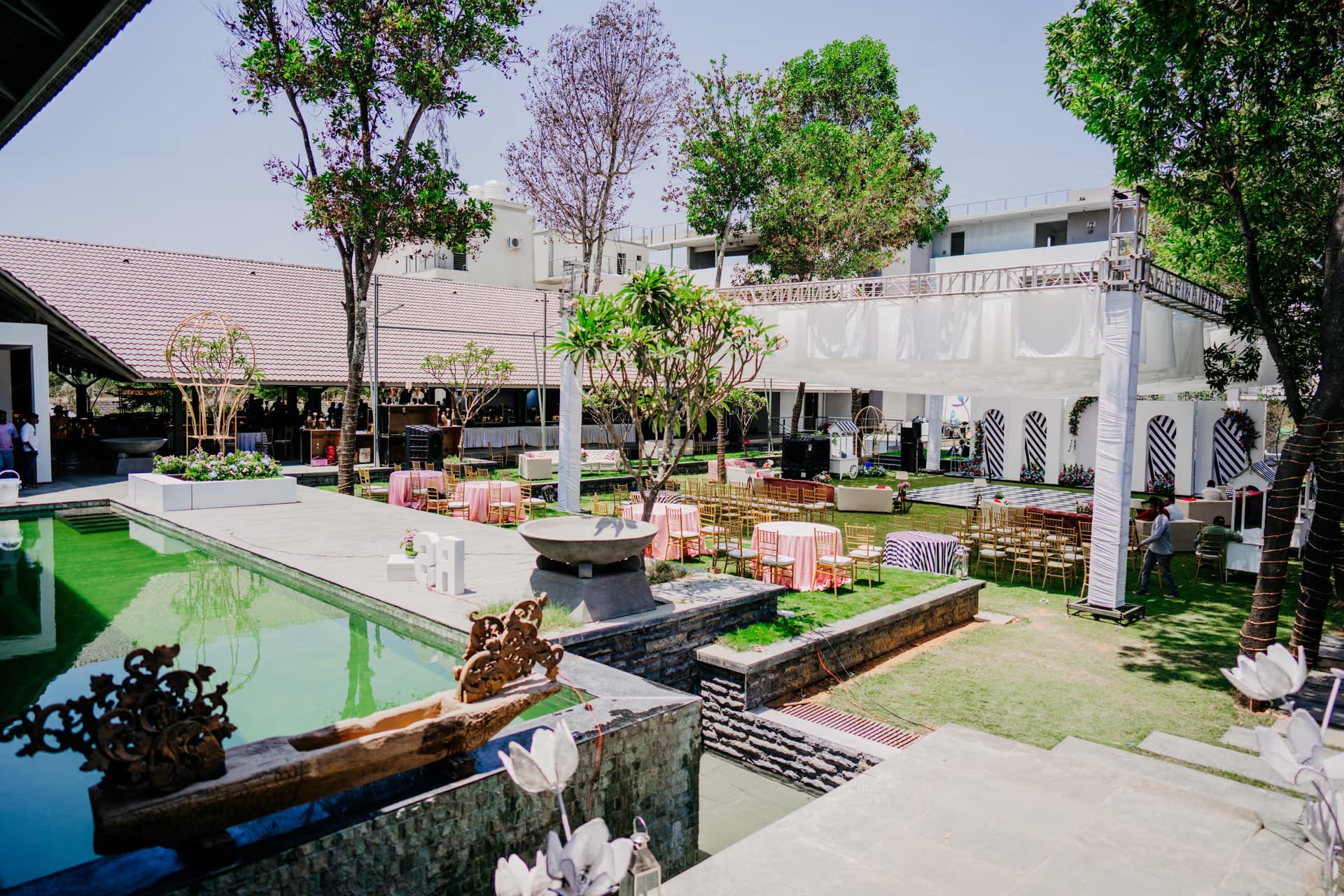
In Bengaluru and beyond, purpose-built estates are also expanding what’s possible. Wiwaha by Praman, in North Bengaluru’s Bettahalsoor/Yelahanka region, is an example of how a venue can be designed around flow and togetherness, Balinese-inspired landscaping, a mix of lawns and indoor halls, and on-site accommodation that supports multi-day hosting. Properties like these reflect an industry insight many planners have felt for years: when the campus is cohesive, the celebration becomes emotionally cohesive too.
Conclusion: Weddings That Feel Personal, Not Performative
A wedding can be grand and still feel intimate. It can be traditional and still feel modern. The difference often lies in what the venue makes possible.
In private estate weddings, connection isn’t manufactured through forced programming; it arises from proximity, privacy, and unhurried time. Guests feel more connected because they are not merely attending, they are staying, witnessing, and living alongside the couple’s story.
Long after the last song fades and the final garland is packed away, what remains is rarely the exact shade of the drape or the height of the centrepiece. What remains is the feeling of being included, of having shared not just a ceremony, but a small world for a while. And perhaps that is the most future-facing idea of all: weddings that feel personal, not performative.